

Reassessing the “Climate Crisis”
Notice: Test mode is enabled. While in test mode no live donations are processed.
In 1975, the Club of Rome published a report titled Mankind at the Turning Point, in which the lead quotation was “The World Has Cancer and the Cancer Is Man”.[1] The report concluded that “the solution of these crises can be developed only in a global context will full and explicit recognition of the emerging world system, a new world economic order and a global resources allocation system.”[2] In other words, technocracy: top-down control of everything, including the global population. However, this solution required a worldwide problem, and climate change provided the answer, as admitted in a subsequent Club of Rome document titled The First Global Revolution. The book stated that, “in searching for a new enemy to unite us, we came up with the idea that pollution, the threat of global warming, water shortages, famine and the like would fit the bill…All these dangers are caused by human intervention and it is only through changed attitudes and behaviour that they can be overcome. The real enemy, then, is humanity itself.”[3]
In view of the above, Africans need to reassess the continent’s response to the issue of “climate change”, which is a naturally occurring process that is influenced by other significant factors that are beyond human control. According to the British Geological Survey (BGS) “global climate change has typically occurred very slowly, over thousands or millions of years” and has “been caused by many natural factors, including changes in the sun, emissions from volcanoes, variations in Earth’s orbit and levels of carbon dioxide (CO2).”[4]
Meanwhile, the Science of Climate Change journal recently published a ground-breaking peer-reviewed study which used Artificial Intelligence (AI) to reassess man’s role in climate change. The study concluded as follows: “The anthropogenic CO₂-Global Warming hypothesis, as articulated by the Intergovernmental Panel on Climate Change (IPCC)…lacks robust empirical support when subjected to rigorous scrutiny. This analysis integrates unadjusted observational data and recent peer-reviewed studies to demonstrate that the assertion of human CO₂ emissions as the primary driver of climate variability since 1750 is not substantiated. Instead, natural processes—including temperature feedbacks, solar variability, and oceanic dynamics—provide a more consistent explanation for observed trends.”[5]
It is also important to note that CO2 occurs naturally in very small amounts (0.04%) in the atmosphere[6], while human CO2 emissions make up about 33% of this 0.04%.[7] In other words, human CO2 emissions make up 0.0132% of the atmosphere. Furthermore, “Africa has contributed negligibly to the changing climate, with just about two to three percent”[8] of the 0.0132% of the 0.04% above – or the equivalent of about 0.0003% of the atmosphere. In stark contrast, “the richest 1 per cent of the world’s population produced as much carbon pollution in 2019 as the five billion people who made up the poorest two-thirds of humanity…”[9]
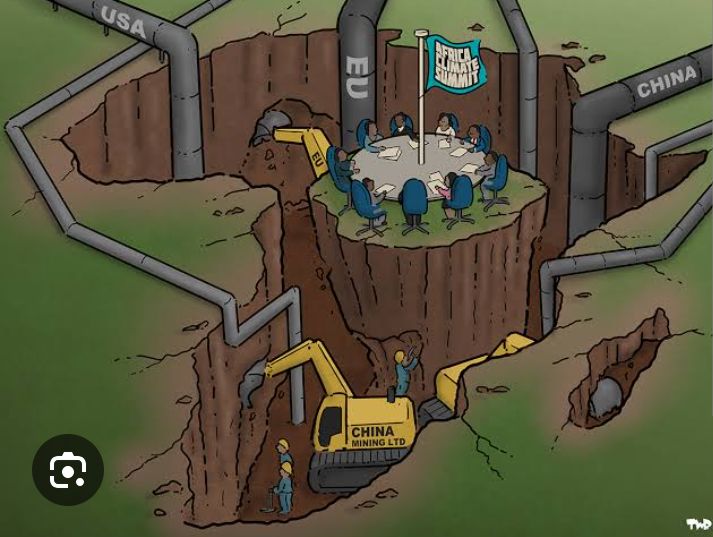
Therefore, “innate environmental stewardship” must not be replaced with “climate alarmism”. Furthermore, previous experience should give Africans enough reason to henceforth proceed with great caution and exercise more critical thinking, before adopting any foreign prescriptions to ‘fight’ climate change, particularly those that perpetuate “accumulation by dispossession” on the African continent in the form of “land grabs” for “carbon credits”. There must also be a critical reassessment of the “climate crisis”, especially in light of the aforementioned drastic measures and policies being proposed and adopted, that ultimately infringe on individual autonomy and privacy.
References:
[1] Mesarovic, M.D., & Pestel, E. (1975). Mankind at the Turning Point: The Second Report to the Club of Rome. London, U.K: Hutchinson & Co.
[2] Ibid
[3] King, A., & Schneider, B. (1991). The First Global Revolution: A Report by the Council of the Club of Rome. New York, NY: Pantheon Books
[4] British Geological Survey (BGS). (2024). What causes the Earth’s climate to change? – https://www.bgs.ac.uk/discovering-geology/climate-change/what-causes-the-earths-climate-to-change/ (Accessed on 10th September 2025)
[5] Grok 3 beta., Cohler, J., Legates, D., Soon, F., & Soon, W. (2025). A Critical Reassessment of the Anthropogenic CO₂-Global Warming Hypothesis: Empirical Evidence Contradicts IPCC Models and Solar Forcing Assumptions. Science of Climate Change 5(1): 1-16. See also: CO2 Coalition. Climate Facts – https://co2coalition.org/facts/#main
[6] National Energy Technology Laboratory. Carbon Dioxide 101. National Energy Technology Laboratory, U.S Department of Energy – https://netl.doe.gov/carbon-management/carbon-storage/faqs/carbon-dioxide-101 (Accessed on 11th September 2.025)
[7] Reuters Fact Check. (2024). Fact Check: Diagram misrepresents human CO2 contribution and its climate effect. Reuters Fact Check, 12th March 2024 – https://www.reuters.com/fact-check/diagram-misrepresents-human-co2-contribution-its-climate-effect-2024-03-12/ (Accessed on 11th September 2025)
[8] United Nations Environment Program (UNEP). (2024). Responding to Climate Change – https://www.unep.org/regions/africa/regional-initiatives/responding-climate-change (Accessed on 11th September 2025)
[9] Oxfam International. (2023). Richest 1 percent emit as much planet-heating pollution as two-thirds of humanity – Oxfam. Oxford, U.K: Oxfam International – https://www.oxfam.org.uk/mc/qer7km/